


Go beyond the initial patch
File owners trace callers, configuration, generated paths and runtime branches that sit outside the coding agent's active context.
 coral-code
You set the task in Codex, Claude or JetBrains Junie. From that same first turn, coral-code coordinates focused agents across the codebase so affected files, runtime paths, tests and cleanup surface before you ship. You remain in charge.

Keep Codex, JetBrains Junie or Claude as the agent you direct. coral-code supplies JetBrains project structure, recorded runtime paths and file-level responsibilities while the harness keeps its own model and permission controls.
File owners trace callers, configuration, generated paths and runtime branches that sit outside the coding agent's active context.
Focused reviews look for partial migrations, weak failure tests, stale adapters and obsolete code after the main implementation lands.
Unvisited files, incomplete reports and missing runtime coverage stay explicit instead of becoming implied confidence.
SWE Atlas is a benchmark for codebase-scale engineering rather than issue resolution alone. It tests whether an agent can understand an existing codebase, write tests that expose failures and carry a refactor across every affected path.
SWE Atlas evaluates codebase understanding, test completeness and refactoring quality. Coral's full-run and controlled studies test whether broader coordination helps coding agents recover more of that work.
coral-code + DeepSeek V4 ProFull 124-task run
Mini-SWE-Agent + Coral
62%
#1
On 29 July 2026, DeepSeek V4 Pro with Mini-SWE-Agent scored 27.15% and ranked #11. The same model and harness with coral-code reported 62% across all 124 tasks. The historical table lists the public configurations between those results on that date. Scale has since added entries, including a later Opus 5 result that Coral does not claim to surpass. Separate controlled studies measured 32.3% to 62.1% with Opus and 29.0% to 50.8% with DeepSeek V4 Pro using the full Coral coordination stack. Scale AI methodology and live leaderboard .
Graph and Timeline show who owns each question, which dependencies move between agents, and where work is blocked. Reported model calls are visible; unavailable usage data stays marked as unknown.
Set the standard, anchor the search, let focused owners work, then resolve what remains before the task ends.
Choose your coding agent, its model and permissions. Use Everyday for routine work or High Certainty when the cost of missing part of the change is higher.
IntelliJ PSI exposes symbols, usages and project boundaries. Recorded coverage and DataFlows connect the task to the paths the application runs.
Bounded file and question agents work in parallel, exchange discoveries and bring in relevant owners as new dependencies surface.
Open unfinished reports, inspect changed files, request another pass or end the task when the remaining risk is understood.
coral-code for your next codebase change.Choose a compatible JetBrains IDE during installation. Current builds need a local JetBrains backend and support Codex, Claude and JetBrains Junie in Agent Chat.
ok to continue.$ curl -fsSL https://downloads.coralcode.dev/install.sh | sh
PS> irm https://downloads.coralcode.dev/install.ps1 | iex
This preview includes bugs and incomplete features. The default configuration uses DeepSeek models.
Sign in to Coral Cloud for a free inner-agent quota. Your outer agent uses its existing subscription.
Add Coral Cloud quota as you run more inner-agent work.
Team subscriptions and annual agreements include managed usage, support and private deployment options.
coral-code@coralos.aiAgent Chat, the project graph, task controls and usage records share one workspace. Move between implementation, delegation and review without reconstructing context in another tool.
Install the early previewTrace dependency ownership, inter-agent messages and reported model calls over time.
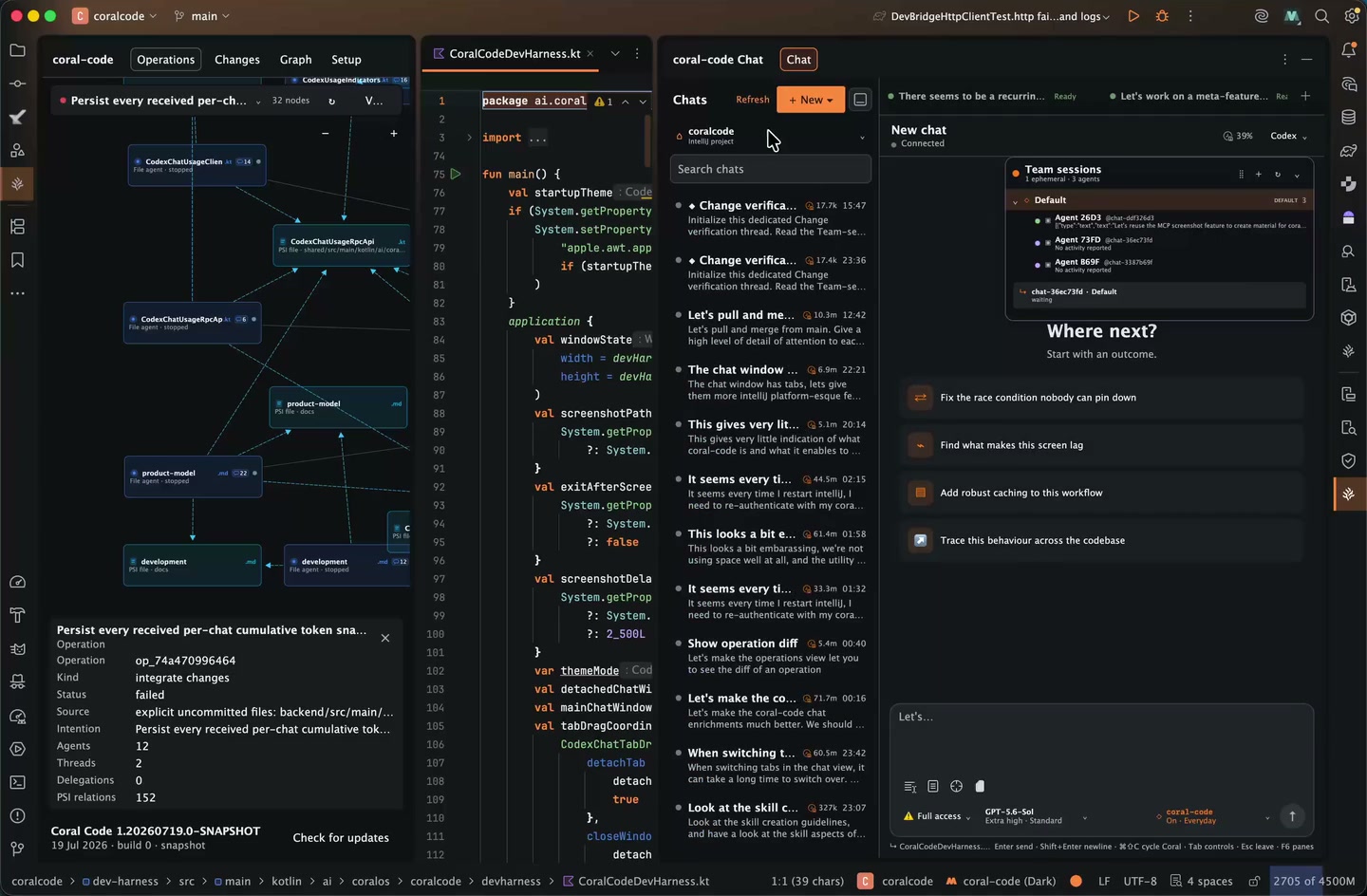
Resume or pause a task, change its model, and keep permissions and Agent Graph mode with the active harness.
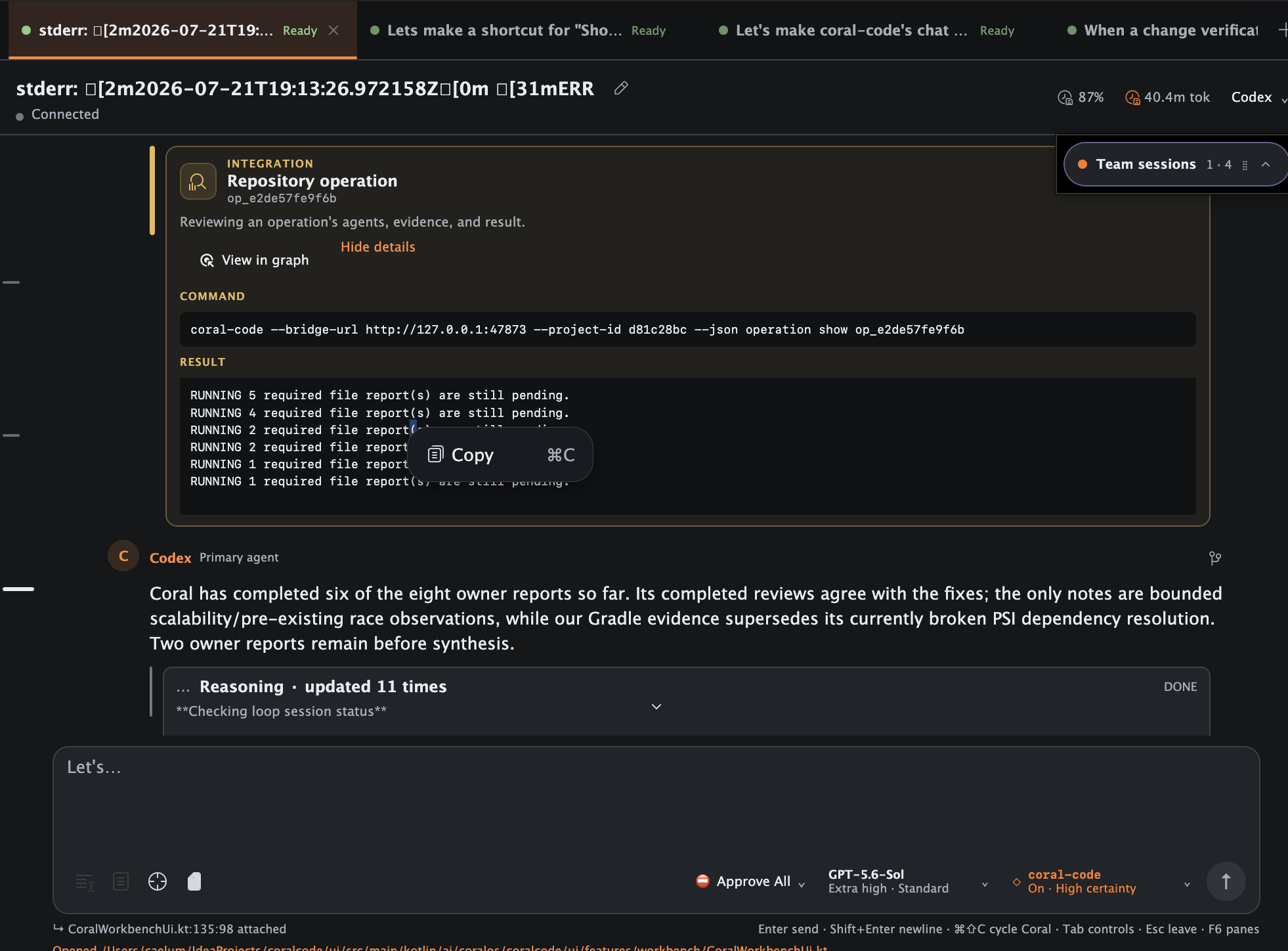
Compare file activity with owner reports, token snapshots and known usage gaps.
In this recorded task, six of eight owner reports are complete while two continue. Open either report, inspect an affected file yourself, or wait before making the final call.

Models, quota, safety and installation.
Updated .
coral-code?coral-code is a JetBrains plugin that puts Agent Chat, Agent Graph, task controls and usage records in one workspace. It works with Codex, JetBrains Junie and Claude.
coral-code help me complete a change?Agent Graph divides the task among bounded file, question and DataFlow owners from the start. They inspect dependencies in parallel and share what they find with the coding agent.
coral-code support?Current builds require a compatible JetBrains IDE and local backend. Agent Chat supports Codex, JetBrains Junie and Claude. Codex uses its account, Junie routes models through Coral Cloud, and Claude uses its own credential.
Agent Graph uses IntelliJ PSI, file relationships, DataFlows and recorded operations to coordinate focused agents.
Use Off for a small edit, Everyday for routine codebase work, and High Certainty when you need broader investigation, explicit gap checks and stronger completion evidence.
Open reports, Graph and Timeline activity, changed files, attempts and observed model usage in the JetBrains workspace.
Incomplete reports and unavailable usage data remain labelled.
Codex uses its existing account and quota. Junie routes model requests through Coral Cloud. Claude uses its own account and credential. Agent Graph agents use the model selected in coral-code settings.
The usage view labels each observed source and marks unavailable account data.
coral-code handle safety and production use?Agent Chat uses the access and approval controls of the selected coding agent. Agent Graph agents use project-scoped PSI tools. The selected coding agent keeps command execution and web access behind its approval controls.
coral-code is an early preview, has not been audited as a sandbox and does not replace code review, testing or human approval.
coral-code?Run the installer for your operating system and accept the early-preview disclaimer. Restart the IDE if JetBrains cannot reload the plugin.
Open the install commands Infrastructure used by
 coral-code
CoralOS provides the Server, Cloud, model proxy and Console behind coral-code. Connect your own agent frameworks, route models, apply budgets and keep operational history under one authority.
coral-code on a change you know well.